
ecobalyse: how do CUB jeans compare to those made in France and Asia?
Buying jeans today is no longer just a question of fit, brand or price. It is also an environmental choice. Behind every pair of trousers lies a complex production chain: cotton cultivation, dyeing, manufacturing, transport, use and end of life.
To objectively assess these impacts, the French government has developed a public tool: Ecobalyse. This environmental label allows textile products to be compared on a common basis.
The results are sometimes counterintuitive.
In this article, we analyse three specific cases using Ecobalyse data:
- Very expensive ‘Made in France’ jeans
- CUB jeans (4109 Ecobalyse points)
- A very cheap pair of jeans imported from Asia (10659 Ecobalyse points)
As a benchmark, a typical pair of ‘Made in France’ jeans scores around 3524 Ecobalyse points.
1. Ecobalyse: how does this indicator work?
Ecobalyse is based on a Life Cycle Assessment (LCA).
It does not just measure CO₂ emissions. The tool has built-in environmental criteria:
- Climate impact
- Water consumption
- Resource use
- Pollution
- Microfibres
- Durability
The calculation covers the entire cycle:
- Raw material cultivation
- Spinning and weaving
- Dyeing and finishing
- Manufacturing
- Transport
- Use (washing, drying, lifespan)
- End of life
The result is expressed in points.
The higher the number of points, the greater the overall environmental impact.
2. Three economic models, three environmental realities
The very expensive ‘Made in France’ jeans – 3524 points
‘Made in France’ has a strong image: proximity, expertise, perceived quality.
Its advantages:
- Local assembly
- Often more limited production runs
- Reduced final transport
But assembly is only one step. The cotton is almost always imported (Turkey, Africa, Asia). The dyes and treatments may be identical to those used elsewhere.
The result: an impact of 3,524 points in a typical case analysed.
This score can be very good... or less favourable depending on the material, the finishes and the actual durability.
Conclusion: the country of assembly alone does not ensure a low footprint.
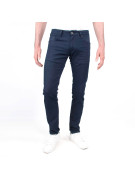
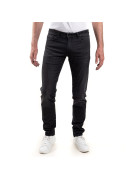
CUB jeans – 4,109 points
The CUB jeans analysed score 4,109 Ecobalyse points.
Its typical configuration:
- Denim sourced from the Mediterranean basin
- High-quality production in a nearby importing country
- Assembled in Tunisia
- Short transport routes
- No air transport
- Controlled finishing processes
- Designed to last
The partner factory operates according to a structured industrial approach, with built-in environmental standards and recycling practices.
The score of 4,109 points places it:
- Well below jeans mass-produced in Asia
- Close to ‘Made in France’ benchmarks
- With a more accessible price point
This result reflects a balance:
regional materials, optimised logistics, sustainable processes, real durability.
Very cheap jeans imported from Asia – 10,659 points
The ultra-competitive style in terms of price operates on a different principle:
- Mass production
- Maximum cost optimisation
- Multiplication of visual effects (stone wash, sandblasting, intensive treatments)
- Complex global logistics
- Shorter lifespan
The score observed is 10,659 Ecobalyse points.
This level of impact is more than twice that of CUB jeans and nearly three times that of a typical Made in France style.
The low price masks a high environmental cost, often linked to:
- Heavy finishing
- Intense chemical treatments
- Limited durability
- Long supply chains
3. What the life cycle analysis really reveals
Ecobalyse data shows that four factors dominate:
1. Raw materials
Cotton often accounts for more than half of the total impact.
Its origin, agricultural yield and processing weigh heavily.
2. Finishes
‘Worn’ effects, intensive washing and multiple treatments greatly increase the environmental footprint.
Visually complex jeans almost always have a greater impact than raw or minimally treated denim.
3. Transport
Air transport radically changes the equation.
A single air freight shipment can undo all the efforts made in production.
Short Mediterranean routes (Turkey – Tunisia – Europe) reduce this impact.
4. Lifespan
Jeans that are worn for a long time see their impact per use decrease considerably.
The strength, quality of assembly and resistance of the denim are decisive factors.
4. Simplified comparative reading
Type of jeans Ecobalyse points Positioning
Made in France (typical case) 3524 Good, depends on the process
CUB jeans 4109 Balance between impact, quality and price
Mass production in Asia 10659 High impact
These figures show that a price difference does not automatically correspond to a proportional difference in environmental impact.
5. CUB positioning: rationality rather than marketing
At CUB, the objective is neither to be the cheapest nor to rely solely on a national label.
The strategic choice is based on:
- Materials sourced from the Mediterranean basin
- Structured, qualitative production from nearby importers
- Short transport routes without air travel
- A factory committed to recycling and responsible practices
- Controlled finishes rather than energy-intensive artificial effects
- Sustainable design
The score of 4109 points reflects this logic:
reducing impact without switching to an inaccessible premium price style.
6. Key takeaways
Very expensive jeans are not automatically the most environmentally friendly.
Very cheap jeans are rarely the most virtuous.
Jeans produced massively at low cost can have an environmental impact two to three times greater than a sustainable style.
Ecobalyse data provides objective insight:
- 3,524 points for a typical Made in France style
- 4,109 points for CUB jeans
- 10,659 points for mass-produced Asian jeans
The difference lies in the materials, processes, logistics and durability.
As environmental labelling becomes more visible, these differences will become clear to consumers.
Transparency is no substitute for choice.
It simply allows you to make an informed choice.